
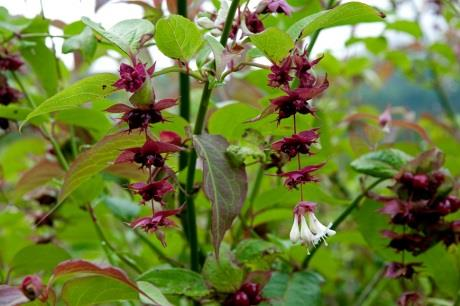
Himalayan honeysuckle (Leycesteria formosa)
Himalayan honeysuckle
Description
Leycesteria formosa, commonly called Himalayan honeysuckle, is a deciduous shrub with arching stems, opposite leaves and showy pendant clusters of tubular flowers often subtended by colourful bracts, followed by fleshy berries. Its ornamental habit and distinctive hanging inflorescences make it recognizable in gardens and along hedgerows, although overall size and vigour vary with site conditions and management. The species is native to the Himalayan region and is widely cultivated outside its native range.
Distribution
In the Azores this species has been recorded only on São Miguel and Terceira, based on available observations. Occurrences tend to be associated with gardens, hedgerows and disturbed ground where plants can escape cultivation, and there is no evidence of it being widespread across the entire archipelago. Continued monitoring and reporting are advisable to clarify whether records represent established populations or isolated escapes.
Management measures
Management should follow an integrated approach combining manual removal or repeated cutting of young plants, careful removal and disposal of fruiting material, and restoration of cleared sites with native species to reduce re‑establishment. Follow‑up monitoring is essential to control seedlings and prevent re‑spread; herbicide use may be considered only as a regulated and professionally supervised option where physical measures are impractical. Avoid moving soil or plant material that could contain seed and report new occurrences to local authorities to aid coordinated action.
Ecological impact
Leycesteria formosa can form dense thickets in suitable conditions and compete with native shrubs and groundlayer vegetation, potentially reducing local plant diversity and altering understory structure. Its fleshy berries are attractive to birds, which can disperse seeds and facilitate establishment away from original planting sites. Although currently recorded only on two islands, further spread could change regeneration dynamics in disturbed habitats and increase pressure on native communities.
Observation
Known only on S. Miguel and Terceira
Related plants
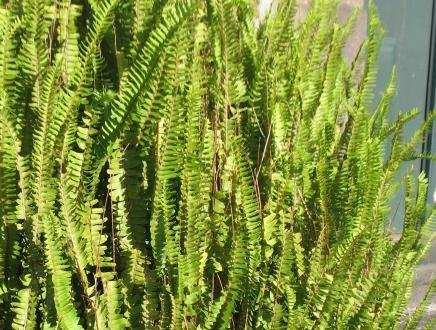
sword fern
Nephrolepis cordifolia
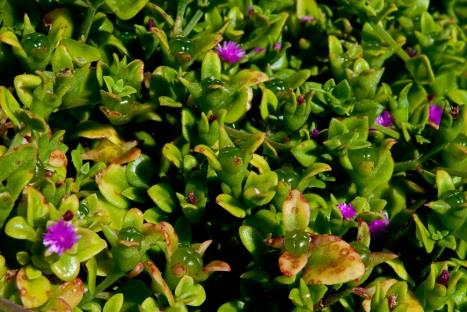
baby sun rose
Aptenia cordifolia
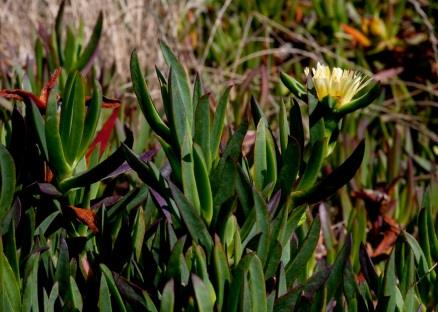
hottentot fig
Carpobrotus edulis
rosea ice plant
Drosanthemum floribundum